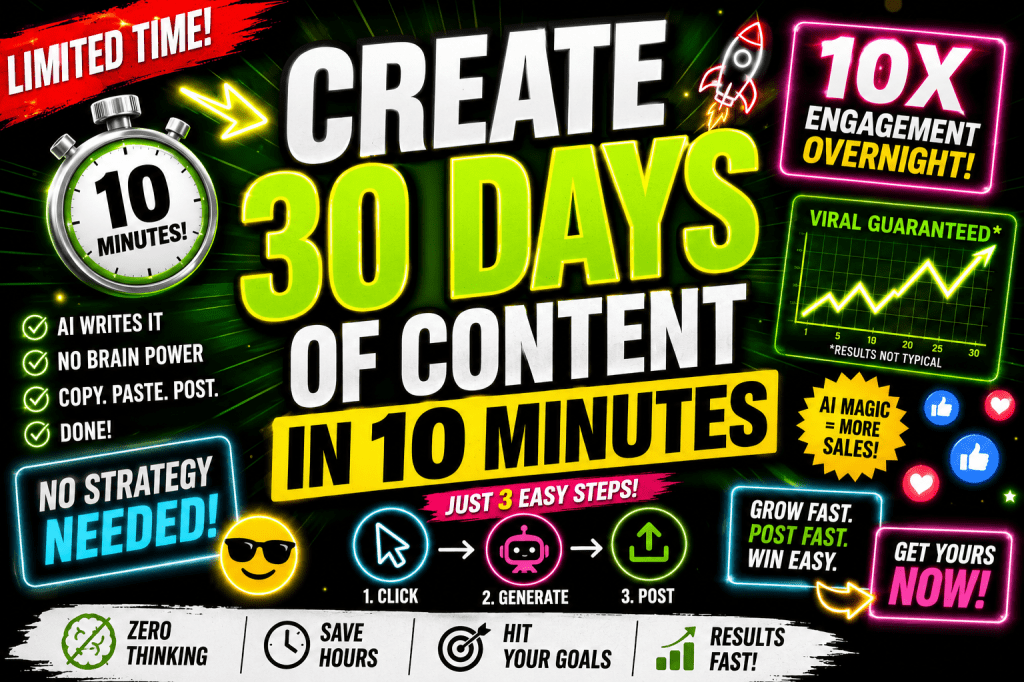
If you spend any amount of time online as a business owner, you’ve probably seen the promises:
- “Create 30 days of content in 10 minutes!”
- “Use this AI prompt and never struggle with content again!”
- “Go viral with this one simple strategy!”
And honestly? Some of these tools and systems can be helpful.
Templates, AI tools, scheduling platforms, and content prompts absolutely have a place in modern marketing. They can save time, help generate ideas, and improve efficiency.
But there’s one problem:
A shortcut is not the same thing as a strategy.
And when small business owners rely entirely on generic content systems without understanding their brand, audience, or goals, the result is often content that feels disconnected, inconsistent, or forgettable.
Why Generic Content Advice Often Falls Short
The biggest issue with one-size-fits-all content advice is that businesses are not one-size-fits-all.
A local physiotherapy clinic, an online coach, a dance studio, and a retail boutique all need completely different types of content because they serve different audiences with different expectations.
Even within the same industry, businesses can have:
- different brand personalities
- different customer demographics
- different goals
- different communication styles
- different buyer journeys
What works for one business may completely fail for another.
That’s why copying trending strategies without doing foundational brand work can actually create more confusion instead of growth.
Content Creation Starts Before the Content
Before building a content calendar, businesses need clarity on their brand foundation.
That includes understanding:
- Who their ideal customer is
- What problems their audience is trying to solve
- What tone and personality fits their brand
- What makes their business different
- What goals their content is meant to support
Without this information, content becomes reactive instead of intentional.
You end up posting because you feel like you should be posting; not because the content is aligned with your business goals.
Step 1: Create Content Pillars
One of the simplest ways to make content creation easier is by developing content pillars.
Content pillars are recurring themes your business talks about consistently online.
For example, a small business might use pillars like:
- educational content
- behind-the-scenes content
- customer stories
- FAQs
- industry insights
- personal brand content
- product or service education
Content pillars help reduce decision fatigue because you’re no longer starting from zero every time you create a post.
Instead, you’re building within a structure that supports your overall messaging.
Step 2: Build a Content Bank
A content bank is one of the most underrated tools for small business owners.
Instead of scrambling for ideas every time you need to post, you create a system for collecting content ideas continuously.
A content bank can include:
- customer questions
- screenshots of comments or DMs
- voice memos
- notes app ideas
- blog topics
- trending conversations
- photo and video folders
- testimonials
- repurposed content ideas
This makes content creation significantly less stressful because you’re no longer relying entirely on inspiration in the moment.
Step 3: Create a Realistic Content Calendar
One of the biggest mistakes businesses make is creating content plans they cannot realistically maintain.
Consistency matters far more than intensity.
Posting five times a day for one week and disappearing for a month usually creates less momentum than posting consistently two or three times per week.
A sustainable content calendar should consider:
- available time
- energy levels
- business priorities
- platform requirements
- capacity for filming/editing/writing
- seasonal promotions
- realistic posting frequency
The best content system is the one you can actually maintain long-term.
Step 4: Use Templates Carefully
Templates can be useful.
AI can be useful.
Scheduling tools can be useful.
But these tools work best when they support an existing strategy; not when they replace one.
The danger of relying entirely on automated or generic content systems is that your content can quickly start sounding like everyone else online.
Your audience doesn’t just want content.
They want clarity, personality, trust, and connection.
And that requires intentional messaging.
What Small Business Owners Can Do If They Can’t Hire a Content Marketer Yet
Not every small business is ready to fully outsource content marketing, and that’s completely understandable.
But even without a full-service content marketer, businesses can still improve their content systems by:
- choosing 2–3 clear content pillars
- organizing ideas into a content bank
- creating reusable workflows
- focusing on audience problems instead of trends
- repurposing existing content
- prioritizing consistency over volume
Small improvements in organization and strategy can make content creation much more manageable.
Why Businesses Hire Content Marketers
Content marketing is often underestimated because people only see the final post.
What they don’t see is the strategy behind it:
- audience research
- SEO planning
- messaging development
- platform optimization
- brand positioning
- content organization
- trend analysis
- editing
- scheduling
- reporting and analytics
Good content marketing is not just “posting online.”
It’s building a communication system that supports trust, visibility, and business growth over time.
And sometimes, even if a business owner plans to manage their own content long-term, hiring a content marketer to help build the foundation, strategy, and systems upfront can save months of frustration and inconsistency later.
Because ultimately, the goal isn’t just to create more content.
It’s to create the right content for your brand.


Leave a Reply